
11th Workshop
Purple Phototrophic Bacteria: Application Potential and Stakeholder Perspectives
14 – 15th May 2026
Thessaloniki – Greece
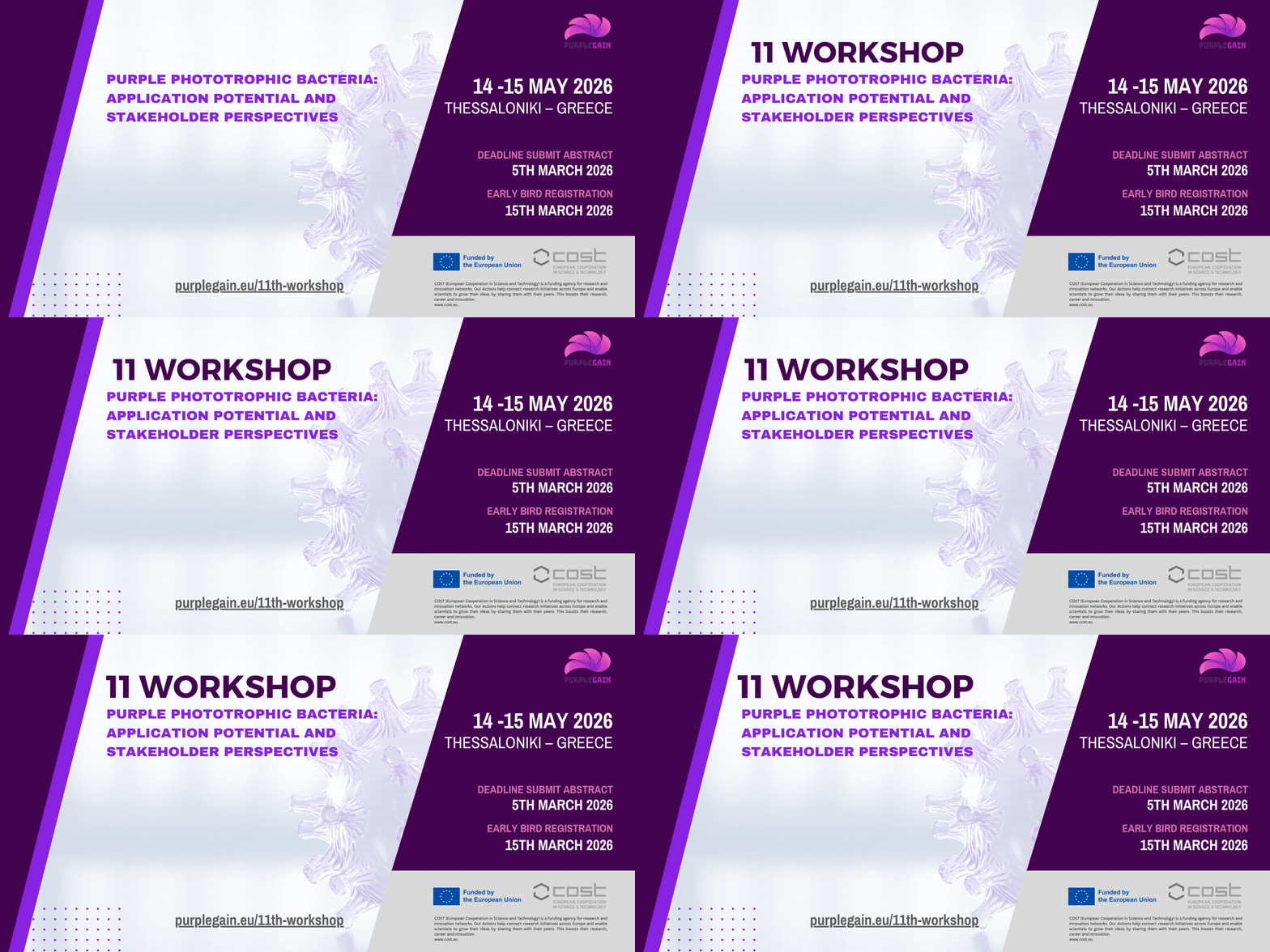
KEY DATES
- Due date for Abstract Submission: 20th March 2026
- Final date to apply for funding: 20th March 2026.
- Notification of selected abstracts and funding results (if applicable, in the form of reimbursement): 25th March 2026
- Deadline for Early bird registration: 15th April 2026
Presentation
This is a call for participating at the 11th Workshop in the frame of WG3 of the COST action (CA21146) – PURPLEGAIN.
11th Workshop (WG3), 14-15 May 2026, Thessaloniki – Greece
Title: “Purple Phototrophic Bacteria: Application Potential and Stakeholder Perspectives”
Organizing committee: Ioanna Vasiliadou (Local Organizer and Training Schools Coordinator), Dr. Konstantinos Kalogiannis (Local Organizer), Dr. Luisa Gouveia (WG3 leader), Dr. Jana Klopchevska, Dr. Senka Vidovic and Dr. Vasileia Vasilaki (WG3 co-leaders), Dr. Raul Muñoz Torre (Grant Awarding Coordinator), Dr. Joana Fradinho (Vice Chair), Dr. Daniel Puyol (Chair).
Key dates
- Due date for Abstract Submission: 20th March 2026
- Final date to apply for funding: 20th March 2026
- Communication, confirmation and funding (if applicable in the form of reimbursement): 25th March 2026.
- Deadline for Early bird registration: 15th April 2026
COST Action
COST Action CA21146
COST Action CA21146 is a four-year networking action that aims at creating a European network to share information, facilitating technology and knowledge transfer between the academic and industrial sectors, related to Purple Photosynthetic Bacteria (PPB) applications for resource recovery from organic waste sources. Resource recovery includes wastewater or organic waste, open or closed environments, in single or chain processes.
The network associates fundamental-focused and applied research groups, improving lab-scale technology optimization through mechanistic modelling. It benefits the technology transfer from applied-research groups to industry, considerably improving process design. PURPLEGAIN also aims to create a database for techno- economic, social and environmental impacts studies, which facilitates the marketability of both the PPB-based technologies and the products to extract. Some focused products are polyhydroxyalkanoates, single-cell proteins, biomass for energy, biohydrogen, biomass as fertilizer, carotenoids, terpenoids, organic acids, coenzyme Q10, and 5-aminolevulinic acid.
COST
COST is an intergovernmental framework for European Cooperation in Science and Technology established to initiate networking and coordination of nationally funded research activities on a European level. It facilitates bringing good scientists together under light strategic guidance based on networks, called COST Actions, centred around research projects in fields that are of interest to COST countries and cooperating countries.
11th Workshop – Purple Phototrophic Bacteria: Application Potential and Stakeholder Perspectives
Call for participating
This is a call for participating in the 11th Workshop
We invite participations as well as abstract contributions (for Oral and Pitches presentations) to this interdisciplinary workshop from:
- PhD students & post-doctoral researchers working on PPB-related technologies.
- Professors & academic researchers exploring PPB applications.
- Start-ups & entrepreneurs developing PPB-based products and processes.
- Technology developers & innovators working on PPB solutions for resource recovery.
We are looking for a broad range of PPB-based innovations, including but not limited to:
- State-of-the-art results from upscaled reactors in PPB
- Novel reactor configurations and illumination strategies (light distribution, LED optimization, spectral tailoring, light-dark cycling, optimization of gas-liquid mass transfer, biomass retention)
- Modelling approaches for PPB systems, including mechanistic, hybrid, and data-driven models, dynamic modelling, and parameter estimation and identification
- Process control, monitoring, and automation for stable and efficient PPB operation
- Bioplastic (PHA) production using PPB to create sustainable, biodegradable alternatives to conventional plastics.
- PPB-based fertilizers and soil enhancers, unlocking the potential of nutrient recovery for agriculture.
- High-value feed and protein-rich biomass for aquaculture and livestock.
- Biohydrogen and bioenergy solutions, leveraging PPB for clean energy production.
- Advanced wastewater treatment & resource recovery, transforming waste streams into valuable products.
- Functional food and nutraceutical applications, such as antioxidant and carotenoid production.
If you have a breakthrough concept, a lab-scale prototype, or a commercial pilot, we want to hear from you!
Abstracts should be maximum 350 words (see Abstract Template) outlining your work, technology, or business case, including:
- Technology/solution description (process, application, or product focus).
- Key technical, regulatory, or investment challenges.
- Potential market impact and sustainability benefits.
Contributors and attendees may apply for financial support (see financial support section).
Program Day
Day 1: 14.5.2026
Theme: Purple Phototrophic Bacteria: Application Potential and Stakeholder Perspectives
Location: CERTH – The Centre for Research & Technology, Hellas
Thermi Thessaloniki – Central Directorate
6th km Charilaou-Thermi Rd, Thessaloniki, Greece
Google maps | Room info
| Time | Title | Speaker |
|---|---|---|
| 8:45–9:15 | Registration | |
| 9:15–9:30 | Introduction | Dr. Ioanna Vasiliadou, Assistant Prof. University of Western Macedonia, Greece |
| 9:30–10:05 | Invited Speaker: Purple Bacteria in the Circular Bioeconomy: From Side Streams to High‑Value Products | Dr. Joana Fradino, Assistant Researcher at NOVA School of Science and Technology | FCT NOVA |
| 10:05–10:40 | Invited Speaker: Photosynthetic Bacterial Cell Factories: China’s Playbook for Scaling | Wenwei Deng, Beijing Dengtong Biotechnology Co., Ltd, China |
| 10:40–11:10 | Coffee Break | |
| 11:10–11:45 | Invited Speaker: Biobased solutions as part of a wider Bioeconomy Strategy for the development of Western Macedonia | CLUBE, Bioeconomy & Environment Cluster of Western Macedonia, Greece |
| 11:45–12:30 | Oral presentations | |
| 12:30–13:50 | Lunch Break | |
| 13:50–14:00 | Presentation of 2nd International Conference on Novel Photorefineries for Resource Recovery | Dr. Senka Vidovic, Professor, Faculty of Technology, Novi Sad University, Department of Pharmaceutical Engineering, Serbia |
| 14:00–14:35 | Invited Speaker: Implementing Circular Waste Management Solutions at Regional Level in Western Macedonia | Dr. Kyriaki G. Sakellariou, DIADYMA Associate, DIADYMA S.A. Waste Management of Western Macedonia, Greece |
| 14:35–15:05 | Invited Speaker: Transforming Municipal WWTPs into Photobiorefineries: Demonstration of ANPHORA® Technology for Nutrient Recovery | Dr. Eugenio Marin, Project Leader – Innovation and Technology Department, Aqualia S.A., Madrid, Spain (online) |
| 15:05–15:30 | Coffee Break | |
| 15:30–16:50 | Oral presentations | |
| 16:50–17:00 | Closure of the day | |
| Evening | Dinner (place will be announced – around 30€ per person) |
Day 2: 15.5.2026
| Time | Title | Speaker |
|---|---|---|
| 8:45–9:15 | Registration | |
| 9:15–9:50 | Invited Speaker: Integrating Microalgae Improvement with Photobioreactor Optimization for Industrial CO2 Conversion in Advanced Biofuel Precursors | Dr. Giannis Penloglou, Assistant Professor, Department of Environmental Engineering, International Hellenic University (IHU), Greece |
| 9:50–10:25 | Invited Speaker: Closing Carbon and Nutrient Loops: An Integrated Microalgae Biorefinery Coupled with Biogas Plants | Dr. Themistoklis Sfetsas, General Manager at QLAB IKE |
| 10:25–11:00 | Oral presentations | |
| 11:00–11:30 | Coffee Break | |
| 11:30–12:30 | Oral presentations | |
| 12:30–13:45 | Lunch Break | |
| 13:45–14:45 | WG3 presentation | WG3 leaders |
| 14:45–15:15 | Coffee Break | |
| 15:15–17:00 | Round Table – Discussion of Subjects proposed by WG3 |
Venue
Location: CERTH – The Centre for Research & Technology, Hellas
Thermi Thessaloniki – Central Directorate, 6th km Charilaou-Thermi Rd, Thessaloniki, Greece
How to get from the center of Thessaloniki to the venue
1. By Bus (Public Transport)
- From the city center, go to a main OASTH bus stop (e.g. Aristotelous Square, Kamara, or White Tower).
- Take Bus Line 66 (direction Thermi) or Bus Line 36 (direction Airport – IKEA).
- Get off at the stop “CERTH / ΕΚΕΤΑ” or “Research Center” (depending on the line).
- Walk for 5 minutes to the CERTH campus.
⏱️ Travel time: approx. 45–60 minutes
🎟️ Ticket: standard urban bus ticket
More information on bus schedule: https://www.oasth.gr/en/
2. By Taxi
- Take a taxi from anywhere in the city center.
- Ask for: “CERTH / EKETA in Thermi.”
⏱️ Travel time: 25–30 minutes
💶 Cost: approx. €25–30
You can use the city’s Taxi service or the app uberTaxi: https://www.uber.com/gr/en/ride/ubertaxi/
Accommodation and Transportation information
Accommodation information
The city center of Thessaloniki is located on Tsimiski Street and there are many accommodation options available, both through Booking and Airbnb.
Some options affordable in the center are:
Transportation information
The best way is to arrive at Thessaloniki’s airport Makedonia- https://www.skg-airport.gr/en/
Then to reach the centre of the city:
1. Rent a car at the airport (Thessaloniki Airport Makedonia)
If you choose to rent a car you can park your car in this parking at the center of Thessaloniki: https://maps.app.goo.gl/TqSJiWy8v2GRATWb7
2. By Bus (Public Transport – Recomended)
- Exit the airport terminal and follow the signs to the bus stop located directly outside.
- Take Bus Line 01X (night line: 01N) operated by OASTH. (other lines also are Line 02K, Line 45A)
- The bus runs frequently (approximately every 20–30 minutes).
- The journey to the city center takes about 35 minutes, depending on traffic.
- You can get off at central stops such as “Aristotelous Square”, “Kamara”.
- Tickets can be purchased from ticket vending machines at the airport or onboard (cash).
More information on bus schedule: https://www.oasth.gr/en/
3. By Taxi
- Taxis are available 24/7 outside the arrivals area.
- The ride to the city center takes approximately 25–30 minutes.
- The cost is usually €20–25 during the day and higher at night
Or use the app uberTaxi: https://www.uber.com/gr/en/ride/ubertaxi/
If you are going to attend the Thraining school in Kozani city, you will be transfer by bus to Thessaloniki via the technical visit the 3rd day 13/5/2026
Financial Support – Application procedure for reimbursement
Documentation for applying
The documentation needed for applying for reimbursement are as follows:
- Applicants must upload a short Curriculum Vitae (in English).
- Applicants must upload a motivation letter (in English).
- Applicants must upload a scanned copy of their passport (if applicants do not have a passport, they can upload their national ID card)
Please, check the General Rules to be reimbursed.
Selection criteria
The selection criteria for participants that will be eligible for reimbursement will comply with the COST Excellence and Inclusiveness Policy, in the implementation of the Action and will encourage attendance by a diverse selection of participants in consideration of:
1. Underrepresented groups, including those with disabilities. Priority will be given to underrepresented groups, including those with disabilities.
2. Gender balance.
3. The level of involvement of Inclusiveness Target Countries (ITCs). Priority will be given to participants form Inclusiveness Target Countries. The current list of ITCs include: Albania, Armenia, Bosnia and Herzegovina, Bulgaria, Cyprus, Czech Republic, Estonia, Croatia, Georgia, Greece, Hungary, Lithuania, Latvia, Malta, Moldova, Montenegro, Poland, Portugal, Romania, Slovenia, Slovakia, Republic of North Macedonia, Republic of Serbia, Turkey and Ukraine.
4. The level of involvement of Early Career Investigators (ECIs). Priority will be given to PhD students and young post-doctoral researchers, followed by senior post-doctoral researchers and professors.
5. In addition, workshop organizers may also consider other special attributes such as:
i) type, or level of expertise in the field of the Workshop based on the curriculum vitae,
ii) appropriate core knowledge and understanding
iii) willingness to participate based on the motivation letter,
iv) demonstrated interest based on the motivation letter,
v) the positive impact that the participation will have on applicant’s future carrier and
vi) willingness to make a presentation in the Workshop session.
Financial contribution
Financial support through reimbursement does not necessarily cover all expenses. A fixed daily allowance of EUR 150 is available for participants. In addition, for travel:
- Up to a maximum of EUR 500 in total can be afforded to each successful applicant from ITC country.
- Up to a maximum of EUR 300 in total can be afforded to each successful applicant from non-ITC country.
- Up to a maximum of EUR 100 in total can be afforded to each successful applicant from Greece (for travel over a distance of 100 km).
Note that locals (from Thessaloniki) cannot claim travel reimbursement. This financial contribution must be understood as financial aid aimed to help applicants to cover the expenses of their participation in the Workshop. This financial aid does not aim to cover 100% of the expenses. When claiming costs in e-COST, please consider that claims higher than the values provided above will be asked for modifications, so please make your claim as accurate as possible to avoid unnecessary delays in the payment.
Please see COST General Annotated Rules to be reimbursed.
Evaluation process and result announcement
Evaluation process
The selection committee, composed of the Action Chair, the Vice Chair, the Grant Awarding coordinator, the Training Schools Coordinator and the WG3 Leaders, and the local organizers will evaluate the applications within a short time period (after the abstract submission deadline) and will inform all the applicants for their evaluation results. The successful applicants will then receive an e-mail from the grant holder (Grant Letter Notification), stating the official approval of the reimbursement, the granted budget and a payment request form which has to be completed after the completion of the Workshop.
Criteria of reimbursement
If the amount of reimbursement by all applications within a call does not exceed the available budget, the applications are handled by the selection committee. If there are more applications than funding is available, the following procedure takes place.
- A list of all applications (containing an informative summary) is distributed to all members of the selection committee in form of a table in which every evaluator can mark which applications he or she can evaluate according to their field of expertise.
- To guarantee a fair and objective evaluation, an evaluator should have no affiliation with neither the home nor the host institution of the application in question.
- All applications are evaluated by two members of the selection committee. The Grant Awarding coordinator distributes the proposals to the individual evaluators.
- The criteria given in the table below shall be applied for evaluation. The first criterion (a) is assessed by the Grant Awarding coordinator prior to the evaluation process.
| Criterion | max. points |
| a) Before any further criteria are considered | |
| Application is complete and fulfils all formal requirements | pass/no pass |
| The application will be ranked last if the applicant was granted in previous call | pass/no pass |
| b) Evaluation of the proposal | |
| Applicant from ITC country | 0 or 20 |
| Applicant is ECI (or promotes gender balance) | 0 or 10 |
| Impact on the career of the applicant | 15 |
| Willingness to participate based on the motivation letter | 10 |
| Willingness to make a presentation in the scope of the Workshop | 20 |
| Participation in PurpleGain Activities | 40 |
| CV of the applicant | 10 |
| Relevance to the objectives of PurpleGain Action | 20 |
- The evaluators report their evaluations to the Grant Awarding coordinator.
- The Grant Awarding coordinator ranks all evaluations and then reports the final result to the selection committee to be discussed and accepted.
- The applicants are informed about the decision reached.
More information
For further information, you may contact the:
- Dr Raul Muñoz Torre – Grant Awarding Coordinator
- Dr Daniel Melchor Puyol Santos – Chair
- Dr. Joana Fradinho – Vice-Chair
- Dr. Ioanna Vasiliadou – Training Schools Coordinator